
-1-1.png?width=50&name=Higher_Elevation_Software_copy-removebg-preview(1)-1-1.png)
.png?height=200&name=The%20Best%20EHS%20Software%20in%202026%20(1).png)

Environmental, health, and safety (EHS) software helps organizations collect, manage, analyze, and...

For successful EHS leaders, Total Recordable Incident Rate is more than yet another data point. Safety directors and operations executives who understand the true meaning of TRIR use this key metric as a direct indicator of risk exposure, operational discipline, and financial stability.
TRIR is OSHA’s standardized rate of workplace recordable injuries and illnesses. It’s one of the most widely recognized safety metrics in the United States, influencing insurance premiums, contract eligibility, brand reputation, and even investor confidence.
Many organizations treat TRIR as a static number, calculating it once per year. High-performing companies use it as a live operational signal.
When you understand the true meaning of TRIR, how to calculate it, how it differs from other metrics, and how modern EHS technology makes tracking and improving TRIR faster and more reliable, TRIR becomes more than another data point. It’s a strategic advantage that increases the value of EHS programs by impacting workplace safety for all
Table of Contents
- What is the Meaning of TRIR?
- How to Calculate TRIR
- How TRIR Differs from Other Metrics
- The Impact of TRIR on Business Success
- The Limitations of TRIR
- Simplify TRIR Calculation, Tracking, and Reporting with EHS Technology
- FAQs
What Is the Meaning of TRIR?
TRIR refers to Total Recordable Incident Rate, a standardized safety metric developed by OSHA to measure the number of recordable workplace injuries and illnesses per 100 full-time employees during a given time period.
Under OSHA recordkeeping rules, recordable incidents typically include:
-
Work-related injuries or illnesses that require medical treatment beyond first aid
-
Cases involving loss of consciousness
-
Restricted work or job transfer cases
-
Days away from work
How to Calculate TRIR
TRIR provides a normalized rate that allows companies of different sizes and across industries to compare safety performance fairly.
Instead of simply counting incidents, it adjusts for total hours worked. Instead of comparing raw incident counts, TRIR standardizes incidents per 200,000 hours worked (the equivalent of 100 full-time employees working a year). That way, a company with 50 employees and a company with 5,000 employees can conduct evaluations that result in comparable results.
The formula is:

The number 200,000 represents the equivalent of 100 full-time employees working 40 hours per week for 50 weeks per year.
For example, if a company had 5 recordable incidents and employees worked 400,000 total hours:
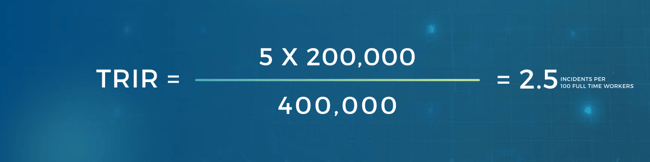
It's a straightforward calculation. The challenge lies in gathering accurate data quickly and consistently. Tracking across fragmented systems or spreadsheets increases the risk of manual errors and delays in reporting.
In contrast, modern EHS platforms ensure real-time visibility into TRIR performance and instant audit readiness by automating tracking and increasing visibility.
How TRIR Differs from Other Metrics
TRIR is often discussed alongside other OSHA safety indicators. While related, these metrics measure different aspects of safety performance. Understanding the distinctions between them helps clarify the full meaning within the broader safety ecosystem.
DART (Days Away, Restricted, or Transferred Rate)
DART measures cases involving more serious outcomes, specifically days away from work, restricted work activity, or job transfers. It excludes less severe recordable incidents. This metric provides insight into incident severity, while TRIR captures total recordables.
LTIR (Lost Time Incident Rate)
LTIR focuses strictly on incidents that result in lost workdays. Lost time incident rate is narrower than TRIR and reflects more significant disruptions.
LWIR (Lost Workday Incident Rate)
Similar to LTIR, LWIR emphasizes lost workday cases, though definitions may vary slightly across industries.
TRIF (Total Recordable Injury Frequency)
TRIF is sometimes used internationally and may rely on slightly different normalization factors depending on jurisdiction.
The key difference is scope. High-performing EHS teams monitor multiple indicators. Because it captures all OSHA recordable cases and provides a broad view of incident frequency, TRIR remains the most universally recognized metric in U.S. regulatory and contractual contexts.
The Impact of TRIR on Business Success
According to the U.S. Bureau of Labor Statistics, private industry employers reported 2.5 million nonfatal workplace injuries and illnesses in 2024. This figure translates into real operational disruptions, costs, and reputational consequences.
The true meaning of TRIR extends far beyond compliance reporting. A high TRIR can influence:
-
Insurance premiums
-
Contract eligibility
-
Client prequalification processes
-
Investor confidence
-
Employee morale
-
Operational uptime
A lower TRIR often strengthens competitive positioning. Clients in industries such as manufacturing, energy, and construction routinely request TRIR data during vendor selection.
Workplace injuries are expensive and can impact profits. Direct costs include medical expenses and workers’ compensation. Indirect costs include production delays, training of replacement workers, administrative time, and reputational damage.
Organizations that proactively manage TRIR demonstrate operational control. That operational discipline signals reliability to stakeholders.
For EHS Directors and Safety Managers, TRIR is also a performance indicator tied directly to KPIs and executive reporting. It becomes part of board-level dashboards.
The Limitations of TRIR
Although TRIR is widely used, it is not a perfect predictor of serious injuries or fatalities.
Because TRIR focuses on recordable cases, it reflects past events rather than future risk. Some safety researchers have argued that lagging indicators like TRIR may not fully capture high-risk exposure or systemic hazards.
That does not diminish its value. EHS managers can lead their organizations beyond compliance by pairing lagging indicators like TRIR with leading indicators such as near-miss reporting, safety observations, and corrective action tracking.
Understanding the full impact and meaning of TRIR requires recognizing both its power and its limitations. Used in isolation, it provides historical insight. Used in combination with tools like real-time dashboards, it becomes a key metric that supports strategic decision-making.
Simplify TRIR Calculation, Tracking, and Reporting with EHS Technology
Calculating TRIR manually once a year may satisfy minimum reporting requirements, but it doesn’t support proactive management. That changes when you use a modern EHS platform like the EHS-Dashboard™. Today’s best technology transforms TRIR from a compliance number into a leadership tool.
-
Centralized dashboards including incident reporting, automated recordability classification, and real-time hour tracking support instant, up to the minute calculation of TRIR.
-
Real-time metrics help executives and managers see current TRIR trends, incident breakdown by department or location, severity distribution, comparisons to industry benchmarks, and more without waiting for year-end reconciliation.
-
Shared reporting capabilities allow EHS teams to distribute consistent, accurate metrics across departments. That transparency builds accountability.
-
Automated calculations increase accuracy and reduce administrative burden.
-
Integrated workflows reduce data silos.
-
Simplified data entry and standardized reporting accelerate monthly and quarterly reviews and ensure alignment between operational data and executive summaries.
When corrective actions are linked directly to incidents within the system, all these capabilities are amplified. TRIR becomes dynamic rather than static, and leaders can transition from reactive reporting to preventive strategy.
Turn TRIR Data Into Action with the EHS-Dashboard™
Understanding TRIR’s meaning is only the first step. Operationalizing it through technology is next. Tracking TRIR consistently with the EHS-Dashboard™ allows organizations to identify patterns and understand the answers to questions like:
-
Are certain facilities driving higher incident rates?
-
Are specific tasks associated with recordables?
-
Is there a seasonal trend?
Dashboards translate raw numbers into actionable insights. When data is accessible and current, discussions become evidence-based rather than anecdotal. Sharing this information supports communication between safety teams and operations leadership.
It's a shift that directly impacts business success. Leaders can prioritize high-risk areas, allocate training resources effectively, and demonstrate measurable improvement over time.
Ready to learn more about how to turn metrics like TRIR into a safer, more sustainable workplace with the EHS-Dashboard™? We'll be happy to give you a personalized product tour. Schedule a demo today.
Frequently Asked Questions
What is the meaning of TRIR?
TRIR stands for Total Recordable Incident Rate. It measures the number of OSHA recordable injuries and illnesses per 100 full-time employees over a given period.
How often should TRIR be calculated?
While OSHA reporting is typically annual, best practice is to calculate TRIR monthly or quarterly using real-time data to proactively monitor trends proactively.
Is a lower TRIR always better than a higher one?
Generally, yes. A lower TRIR indicates fewer recordable incidents. However, TRIR should be evaluated alongside other safety metrics to understand overall risk exposure.
How is TRIR different from DART?
Breakdowns often stem from failure to adhere to Control of Work best practices, as well as from communication gaps, poor visibility into active work, and disconnected processes for isolations, SIMOPS, and handover. Paper-based workflows make those gaps harder to detect.
How do digital systems improve Control of Work?
TRIR includes all OSHA recordable incidents. DART measures only cases involving days away from work, restricted work, or job transfers.
Can software like the EHS-Dashboard™ automatically calculate TRIR?
Yes. Modern EHS systems automatically apply the TRIR formula by integrating incident data with total hours worked, reducing errors and saving time.

.png?height=200&name=non-compliance-blog_image%20(1).png)